
Can we change the narrative?
Welcome to another entry of The Integrated Masculine Man.
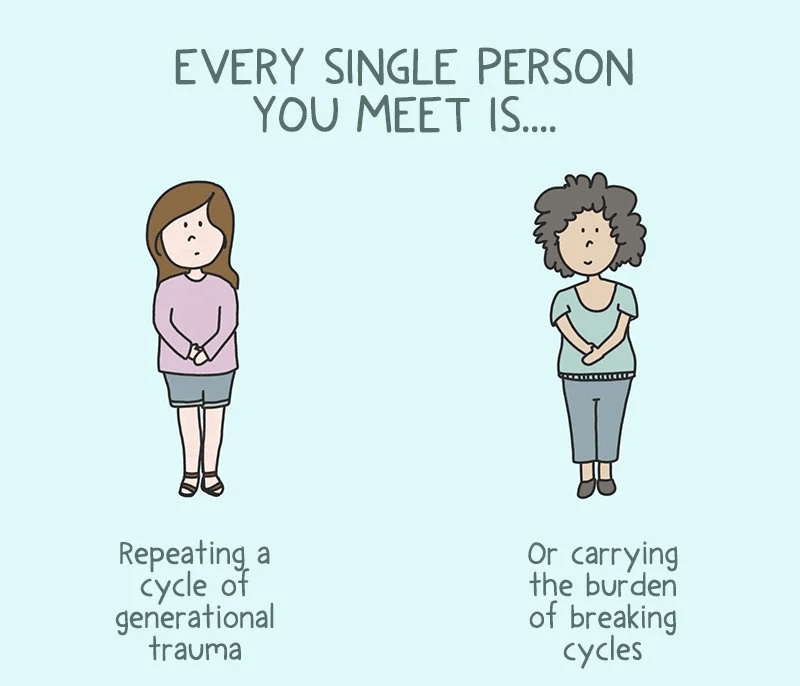
Generational trauma isn’t just about the past—it’s about the patterns that shape our present and influence our future. We inherit more than just eye colour and personality traits; we also inherit struggles, beliefs, and ways of coping that have been passed down for generations. Some of these patterns serve us well, but others keep us stuck in cycles of hardship, pain, and limitation.
But here’s the thing: while we may not be responsible for the hardships of our ancestors, we are responsible for what we pass on to our children. We have the power to break the cycle and create a new legacy.
In this entry, we’re going to unpack some of the most prevalent forms of generational trauma—economic hardship, racial discrimination, substance abuse, mental health stigma, environmental anxiety, gender inequality, and technological overload. More importantly, we’ll explore practical, meaningful ways to heal and move forward with resilience and intention.
Economic hardship
If there’s one thing I’ve learned about money, it’s that financial literacy is not taught at an acceptable level in Australia. Schools might teach you how to calculate compound interest, but they don’t teach you how to apply that knowledge to real-life budgeting, investing, or wealth-building.
Whether your parents were wise enough to plan for their future generations, it won’t matter if you haven’t had any financial literacy imparted upon you. I’ve seen firsthand relatives who’ve inherited literal millions, only to be broke not even a matter of years later, simply because they had no financial literacy.
Everything I’ve learned about money—how to save, invest, and grow wealth—has come from friends who took the initiative to educate themselves through books, podcasts, and trial and error.
Growing up, I saw firsthand how a lack of financial knowledge can keep people stuck in a cycle of scarcity. When money is always tight, you learn to think short-term: making ends meet becomes the priority, not planning for the future. That mindset is hard to break when you’re constantly in survival mode.
Now, as a parent, I refuse to let my son grow up financially clueless. I make a point to talk to him about money—not in a way that stresses him out, but in a way that empowers him. We discuss saving, spending wisely, and the importance of giving to others. But I’m not stopping with just him. I’ve also found myself sharing what I’ve learned with friends and coworkers, because financial literacy isn’t something that should be hoarded—it should be expanded. The more we talk about it, the more we can break the cycle of financial struggle together.
Breaking the cycle of economic hardship isn’t just about earning more money; it’s about shifting our entire approach to money. If we, as a generation, can change how we think about finances, we can set up future generations for success instead of struggle.
How we can break the cycle:
- Financial Education: Take the initiative to learn about money through books, podcasts, and trusted financial educators.
- Teach the next generation: Have open conversations with children about money management from an early age.
- Share knowledge: Talk to friends, coworkers, and family members about financial strategies to collectively improve financial literacy.
- Plan for the future: Focus on long-term financial stability rather than just short-term survival.
Racial discrimination
The legacy of racial discrimination is profound, impacting families across generations. From segregation and redlining to microaggressions in the workplace, racial trauma is a heavy burden to carry. Many families pass down coping mechanisms—some healthy, some not—as a way to navigate a world that often feels unfair.
I’ve seen racial discrimination firsthand, having lived in a small Australian mining town. One of the most devastating examples I witnessed was when the government shut down remote Indigenous communities, forcing people to relocate to major towns just to access basic food and water services. On the surface, these closures were justified as economic decisions, but the reality was much deeper. Many of these communities were stuck in a cycle of relying on government handouts, which were often used to purchase alcohol and other substances. Substance abuse became a way to cope with generations of trauma, but it also fuelled further suffering—leading to neglect, abuse, and even violence within families.
This is what generational trauma looks like in real-time: pain that manifests in harmful ways, passed down again and again.
The over representation of First Nations people in the justice system must be understood in the context of their experiences of colonialism. In Australia, the incarceration rate for Indigenous people is 2,559 per 100,000, and this number keeps growing year on year. Additionally, Indigenous schooling attendance rates are significantly lower than those of non-Indigenous students. Both of these figures are direct correlations of the generational trauma caused by colonisation.
I believe that while acknowledgements of country and symbolic gestures are important for spreading awareness, they are not enough on their own. Real change requires action—practical steps that go beyond words.
How we can break the cycle:
- Support Indigenous-owned businesses and initiatives: Economic empowerment is crucial. Buy from Indigenous-owned businesses, artists, and entrepreneurs to help create financial independence.
- Advocate for policy change: Push for better funding and resources in Indigenous communities, including healthcare, education, and housing.
- Volunteer and engage locally: Work with organisations that provide direct support to Indigenous families and communities.
- Educate beyond the basics: Learn about Indigenous history and the systemic barriers still in place today. Share this knowledge with others to challenge ignorance and misinformation.
- Listen to Indigenous voices: Amplify the voices of those directly affected by racial discrimination rather than speaking for them.
Substance abuse
I grew up in a home where substance abuse was a daily reality. Both of my parents struggled with chronic drug addiction, and now, thirty years later, my father still does. The impact of addiction doesn’t just affect the person using—it spreads through the family, leaving behind confusion, instability, and pain. As a child, I often felt like I had to navigate life on my own, not knowing what version of my parents I’d come home to.
Because of that, I’ve made it a priority to do things differently with my own son. I don’t want substance use to be a taboo topic in our home—I want him to feel safe coming to me with questions and concerns. I believe that education and moderation are key. Rather than pretending addiction doesn’t exist or using scare tactics, I’m committed to having open and honest conversations with him about drugs, alcohol, and the importance of making informed choices.
I want my son to know that no matter what he faces in life, he can always talk to me without fear of judgment. I’m building a relationship with him where trust is at the core, so he never feels like he has to hide his struggles the way I once did. Breaking this cycle isn’t just about saying no to addiction—it’s about creating a foundation of honesty, support, and resilience.
How we can break the cycle:
- Breaking the silence: Address addiction openly rather than sweeping it under the rug.
- Education over fear: Teach kids about substance use in a way that’s factual and balanced, rather than purely punitive.
- Creating a safe space: Foster an environment where children feel comfortable discussing difficult topics without fear of punishment or rejection.
- Modelling healthy coping mechanisms: Show younger generations that stress can be managed through mindfulness, exercise, therapy, or creative outlets rather than substance use.
Mental health stigma
Like so many in my generation—I grew up in a household where “boys don’t cry” was practically a rule. Emotions weren’t something you talked about—they were something you buried. If you were sad, you sucked it up. If you were angry, you kept it inside. That’s just how it was. And for a long time, I didn’t even question it.
Now, as a parent myself, I see how damaging that mindset is, and I refuse to pass it down to my son. In my house, emotions aren’t a weakness; they’re a language we’re learning together. When he cries, I don’t tell him to “man up.” Instead, I sit with him, help him name what he’s feeling, and let him know it’s okay to feel that way. If I lose my temper and go off on him, I make it a point to apologise and explain why I was upset—because I want him to know that adults make mistakes too, and accountability isn’t just something kids have to practise.
Breaking the cycle means showing him that emotions are not the enemy. They’re part of being human. And by doing that, I hope he grows up knowing that his feelings matter and that vulnerability is strength, not weakness.
How we can break the cycle:
- Normalise therapy and counselling: Seeking professional help should be as normal as visiting a doctor for a physical illness.
- Teaching emotional intelligence: Teach children how to name and express their emotions in a healthy way.
- Changing the stigma around mental health: Talk openly about depression, anxiety, and other mental health conditions to reduce fear and ignorance.
Environmental anxiety
It’s impossible to ignore the fact that our planet is getting hotter and hotter. Every summer seems more extreme than the last, and it has a lot of people—myself included—questioning what kind of world we’re leaving behind for future generations. The weight of environmental anxiety is real, and it’s easy to feel powerless in the face of such a massive global crisis. But while we can’t individually reverse climate change, we can make an impact through the choices we make every day.
For me, taking action is one of the best ways to combat the hopelessness that comes with environmental anxiety. I recently ordered my first electric car—not just as a cool tech upgrade, but as a way to reduce my carbon footprint and do my part. It’s a small step, but one that aligns with my values. The way I see it, if more of us commit to making small changes, those efforts add up.
And the good news? Making a difference doesn’t require massive sacrifices. Simple everyday actions—like reducing waste, cutting back on single-use plastics, and supporting sustainable brands—can create real change. Even things like turning off lights when you leave a room, carpooling when possible, or being mindful about water usage can collectively make a big impact.
I also make sure to have open conversations with my son about environmental responsibility. I want him to grow up understanding that we all have a role to play, and that taking care of the planet isn’t just about doom and gloom—it’s about making smarter, more sustainable choices that improve our quality of life.
How we can break the cycle:
- Reduce and reuse: Cut back on single-use plastics, recycle properly, and choose reusable alternatives when possible.
- Be energy conscious: Turn off unnecessary lights, switch to LED bulbs, and unplug electronics when not in use.
- Support sustainable brands: Choose companies that prioritize ethical sourcing and environmental responsibility.
- Make Eco-friendly transportation choices: Walk, bike, carpool, or consider an electric vehicle if possible.
- Educate the next generation: Talk to kids about environmental issues in a way that empowers them to take action.
The reality is, we don’t need a handful of people living perfectly sustainable lives—we need millions of people making imperfect but meaningful efforts. If we all do our part, future generations won’t have to suffer the consequences of our inaction.

Gender inequality
For generations, rigid gender roles dictated what men and women should do—who should work, who should stay home, who should lead, and who should follow. But thankfully, we’re seeing those roles shift. More women are choosing careers over starting families, and more men are becoming actively involved fathers rather than just financial providers. These changes are crucial in breaking the cycle of gender inequality, but there’s still a long way to go.
I grew up in a world where certain expectations were placed on people based solely on gender. But in raising my son, I want to ensure he grows up knowing that respect, emotional intelligence, and equality aren’t just buzzwords—they’re values to live by. That means teaching him that household responsibilities are shared, that emotions aren’t a weakness, and that women’s ambitions deserve the same respect as men’s.
The way we parent and the conversations we have matter. Small, everyday actions—like encouraging boys to express their emotions or ensuring girls feel confident in leadership roles—help dismantle outdated expectations. If we continue to challenge gender stereotypes and celebrate equality in our daily lives, we can create a world where opportunities aren’t limited by gender.
How we can break the cycle:
- Challenge gender norms at home: Share responsibilities equally and encourage emotional expression in all children.
- Support women in leadership: Uplift women in workplaces, communities, and politics.
- Teach consent and respect early: Have open conversations with kids about boundaries, consent, and mutual respect.
- Encourage equal parenting: Support and normalise fathers being actively involved in childcare and household duties.
- Call out inequality: Speak up when you see gender bias, whether in the workplace, media, or everyday interactions.
Technology overload
When I was a kid, there was no internet. My first game consoles were absolute dinosaurs compared to the smart devices we give our children today. The rapid advancement of technology is incredible, but it also comes with major challenges—especially when it comes to social media. We’re already seeing the significant impact it has on teenagers’ mental health in a negative way, and who knows what the long-term effects will be?
The key to breaking this cycle isn’t avoiding technology altogether—it’s teaching our kids how to use it responsibly.
How we can break the cycle:
- Set screen time limits: Encourage balance between online and offline activities.
- Educate early: Talk to kids about online safety, cyber-bullying, and misinformation
- Lead by example: Model healthy tech habits by setting boundaries for yourself too.
- Encourage outdoor and offline activities: Promote hobbies that don’t involve screens.

Breaking the wheel
Breaking generational trauma isn’t easy. It requires awareness, effort, and sometimes painful conversations. But it’s also one of the most powerful acts of love we can give to ourselves and future generations. By healing these wounds, we rewrite the narrative of our families and pave the way for healthier, happier lives.
I hope you’ve enjoyed this entry of The Integrated Masculine Man. While I’ve only covered a few examples of generational trauma, there are many more out there. If there’s a specific topic you’d like me to dive into in a future entry, let me know in the comments!
What cycles are you working to break in your family? Share your experiences and insights—I’d love to hear your journey toward healing.
-TIMM


Leave a comment