
The hidden threads that bind us
Over seven billion humans now populate our tiny speck in the vast cosmos—and yet, again and again, we find ourselves bumping into familiar names in unfamiliar places. A friend of a friend. An ex from your past dating someone new in your circle. Someone’s cousin who once went to school with your sister. It’s enough to make you pause and say, “The world isn’t so big after all.”
It turns out, there’s a theory for that. And it’s one of my favourite ideas in all of sociology.
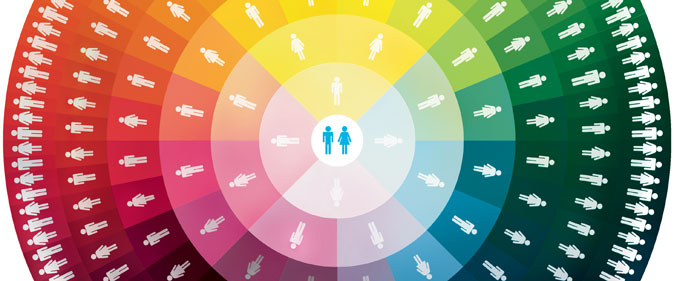
If you’ve never heard of the six degrees of separation, it is a theory that essentially suggests that everyone in the world is connected through a chain of no more than six people. In other words, if you take any two people on the planet, they are connected through a series of acquaintances (friends, colleagues, etc.), and that chain will never be more than six links.
The theory first took shape in the 1960s, when psychologist Stanley Milgram set out to test just how interconnected people really are. In what became known as the “small world experiment,” Milgram asked participants in Nebraska to send a letter to a stranger in Massachusetts. But they couldn’t send it directly—they had to pass it along to someone they thought might be closer to the target. On average, the letter reached its destination in just six steps.
Milgram’s experiment wasn’t perfect, but the results were powerful. They hinted at a hidden architecture of connection—proof that we’re far more linked than we tend to believe.
“We’re not meant to go it alone. We’re meant to reach out and discover the unseen threads that tie us together.”
For example, you might know someone who knows someone who knows someone (and so on) until you reach a person on the other side of the world. It’s based on the idea that the world is much smaller than we think, and we’re all connected in a huge global web, even if we don’t realise it.
It was popularised by the concept of “six degrees of Kevin Bacon,” where people try to link any actor to Kevin Bacon in six steps or less based on movies they’ve been in with other actors. The theory emphasises how quickly we can be linked to others, no matter how far apart we seem.
The Kevin Bacon effect
The concept of Six Degrees of Kevin Bacon originated in 1994 as a playful extension of the six degrees of separation theory. It was the result of a conversation between three college students—Craig Fass, Brian Turtle, and Mike Ginelli—who were watching a movie starring Kevin Bacon. They jokingly wondered how many people it would take to link Kevin Bacon to any other actor through their movie roles.
The idea was that Kevin Bacon had worked with so many actors that he could be connected to almost any actor in the world in just six steps or fewer. The game became a sort of pop culture phenomenon, with people using it to see how many connections it would take to link any actor to Bacon.
In 1994, the New York Times picked up on this idea after a mention in an article about the game. The trio turned their idea into a full-blown game called “The Oracle of Bacon,” a website that calculated how many steps it would take to connect any two actors through their movie roles.
It was all in good fun, but it also highlighted the “small world” concept: that through the right connections, we’re all linked together in ways that are surprising and often much closer than we think.
Kevin Bacon himself has embraced the phenomenon, and it even led to him starting the Bacon Brothers band, further ingraining the idea of being “connected” in popular culture.
We like to think of ourselves as self-made, solitary, or independent—and sure, that’s a powerful story. But if six degrees of separation has taught me anything, it’s that we’re not meant to go it alone. We’re meant to reach out and discover the unseen threads that tie us together. Every handshake, every conversation, every shared moment with someone new might be part of a wider, more meaningful web. The beauty lies in not always knowing the destination—just trusting that connection matters.
It’s a small world after all
I live in a city with a population nearing two million people. I’ve not lived here my whole life, rather not even ten years. Yet I keep meeting people who remind me how small the world really is—and how real this six degrees thing might be.
My most recent partner for example, I met at my gym. We’d never met before, nor did we know of each other prior. Yet as we got to know one another, she had grown up in the small mining town where I had moved from—her leaving it around the time I moved there. As we marvelled over this, it turned out that she had grown up living nearby to cousins of my own family. I was so taken aback how this person whom I had met in the city had indirectly been involved in my family’s life, and here we were meeting some twenty or so years later.
“Every stranger carries a thread that could lead back to your life.”
Another one that comes to mind was a woman I met on a night out, who I went on a few dates with afterwards. As it turns out she had also come from the same small mining town, and had even dated my son’s mothers’ older brother! Two things crossed my mind at this time; the first being that I don’t know what I’ve done for the universe to keep bringing me women from the same damn town, and the second being “how the hell is this city so damn small?“
Even this week in conversation with my sister, she mentions that she’s trying a new daycare out for my baby nephew, and one of the early childcare employees just happened to go to school with her, in the same grade no doubt, in that very same small mining town ironically.
The wild part about six degrees of separation is how often it proves itself true in the most casual moments. You meet someone new, and before you know it, you’re tracing a trail of mutual friends, shared history, or uncanny small-town ties. It’s uncanny. And it’s a reminder that every stranger carries a thread that could lead back to your life. That kind of mystery makes human connection feel like an adventure—a subtle reminder to stay curious with the people we meet.
Real vs. digital: What counts now?
In a world where we’re constantly connected, the question isn’t whether the six degrees of separation still exist—but what they mean in the digital age. Does a mutual follow on Instagram count? Is a LinkedIn connection really a connection at all?
We live in a time that confuses visibility with intimacy. A few thousand followers might feel like a kind of popularity, but they don’t always equate to depth. That’s where I find myself pulling back and reflecting: it’s not about how many followers you have—it’s about who would show up if you called. Who’s in your corner when things fall apart? Who answers the phone at midnight? That’s where real connection lives—in presence, not in profiles.
“It’s not about how many followers you have—it’s about who would show up if you called.”
For me, the answer is deeper than clicks and follows. True connection still lives in shared stories, strange coincidences, and those moments when the universe reminds you that someone you just met somehow knew your family 20 years ago.
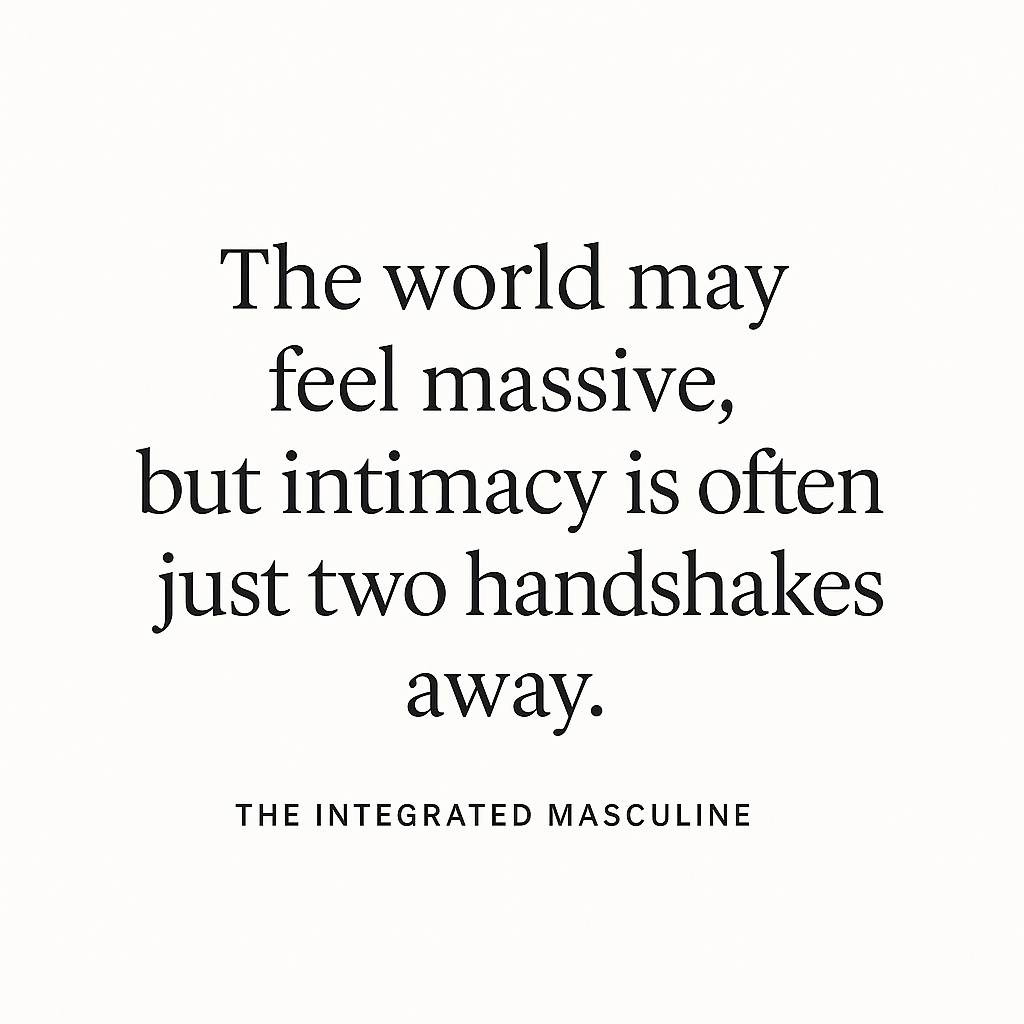
The theory of six degrees reminds me of something powerful: you are never as isolated as you think. Your next mentor, opportunity, or friend might already be two handshakes away. In a time where loneliness is epidemic, that’s not just comforting—it’s liberating.
So, here’s something to sit with:
Who are you already connected to that you haven’t realised yet?
That old friend you haven’t checked in on. The stranger you see every week at your gym. The colleague whose story you’ve never asked to hear.
The world is offering you connections all the time—what would change if you paid more attention to them?
Stay open, stay curious, and never underestimate the power of saying hello. The world is smaller than it looks.
–TIM
 The Integrated Masculine
Leave a comment