
Disclaimer:
I’m not a psychologist, therapist, or expert in attachment theory. I’m just a man who’s spent years exploring this space—through reading, conversation, and lived experience. This entry isn’t advice, it’s simply a reflection on what I’ve learned and how it’s helped me grow. Take what resonates, and leave the rest.
Attachment styles are something I’ve come to familiarise myself with over the past few years. Initially, I thought they were just about how we behave in romantic relationships—clingy, distant, secure, avoidant. But I’ve since come to understand they run much deeper. Our attachment style influences how we relate not only to our partners, but to our children, our parents, our friends, and even our colleagues.
It shows up in how we deal with conflict.
How we respond to stress.
How we navigate the messy and beautiful complexities of human connection.
Childhood: where it all begins
Our attachment style is largely formed in early childhood—long before we’re even aware of it. In those formative years, our brains are wiring themselves for survival, and our nervous system is learning to interpret the world as either safe or unsafe based on the care we receive.
If we had caregivers who were consistently available, emotionally attuned, and responsive to our needs, we likely developed what’s known as a secure attachment. We learned to trust others, regulate our emotions, and form healthy bonds.
But if our caregivers were inconsistent, dismissive, neglectful, or intrusive, we may have developed insecure attachment styles—as a form of adaptation. Not because we were broken, but because our young minds were doing their best to survive emotionally in an unpredictable environment.
And those adaptive strategies? They often follow us into adulthood.
The four main attachment styles
Let’s break down the four primary attachment styles:
1. Secure attachment
People with a secure attachment style are comfortable with intimacy and autonomy. They trust easily, communicate openly, and can navigate conflict without shutting down or becoming overwhelmed.
Signs of secure attachment:
- You feel comfortable depending on others—and having them depend on you.
- You communicate your needs clearly and directly.
- You’re okay with space in a relationship without spiraling into anxiety.
- You can self-regulate during conflict.
2. Anxious attachment
Those with an anxious attachment style often fear abandonment. They may crave closeness, reassurance, and constant validation, but can also be hypersensitive to perceived rejection or distance.
Signs of anxious attachment:
- You often worry your partner doesn’t love you as much as you love them.
- You overanalyse texts, silences, or tone.
- You find it hard to be alone or without constant connection.
- Conflict feels threatening, not constructive.
3. Avoidant attachment
Avoidantly attached people tend to suppress their emotional needs. They may value independence to an extreme, feel uncomfortable with vulnerability, and pull away when things get emotionally intense.
Signs of avoidant attachment:
- You feel smothered or overwhelmed by emotional closeness.
- You value independence so much that you avoid relying on others.
- You shut down during conflict or emotionally intense conversations.
- You often feel more comfortable alone than in intimate partnership.
4. Disorganised (fearful-avoidant) attachment
This style is a mix of both anxious and avoidant traits, often stemming from trauma or chaotic caregiving environments. People with this style deeply crave connection but also fear it, resulting in a push-pull dynamic in relationships.
Signs of disorganised attachment:
- You want love, but fear it at the same time.
- You may sabotage intimacy, then feel guilty for pushing people away.
- Your relationships often feel turbulent or unsafe.
- You struggle with trusting yourself and others.
How it shows up in adult life
What’s been most eye-opening for me is realising how attachment styles show up far beyond our romantic lives. It can explain:
- Why you avoid tough conversations with your boss.
- Why you’re exhausted by friendships that feel one-sided.
- Why you struggle to set boundaries—or struggle to keep them.
- Why parenting can feel so triggering, especially when it mirrors the parenting you received.
Your attachment style might influence the way you speak—or don’t speak. Whether you feel safe asking for help. Whether you interpret silence as space or as rejection.
And often, we’re not reacting to the present moment…
We’re reacting to a memory. A pattern. An emotional echo from childhood.
The attachment dance in relationships
When two people with different attachment styles come together, it can create what’s often referred to as the attachment dance—a push-and-pull dynamic that can feel confusing, exhausting, or even painful. But it’s not chaos for the sake of chaos—it’s two nervous systems doing their best to get their needs met, often in opposing ways.
Here are a few of the most common combinations and what they tend to look like:
Anxious + avoidant: The classic chase
This is the most well-known pairing—and often the most triggering. The anxious partner seeks closeness and reassurance. The avoidant partner needs space to self-regulate. The more one clings, the more the other distances. Both people feel unsafe, but for opposite reasons.
How it plays out:
- One person sends long texts, the other replies with “k.”
- The anxious partner feels abandoned.
- The avoidant partner feels overwhelmed.
- Eventually, the avoidant shuts down, and the anxious partner panics—or explodes.
Until each person understands their pattern, this cycle can repeat endlessly.
Anxious + anxious: The emotional rollercoaster
Both partners crave closeness and can become highly attuned to each other’s moods—but often without the tools to self-soothe. Emotions escalate quickly. Conflict can spiral. There’s lots of passion, but not always peace.
How it plays out:
- Fights get big fast.
- Apologies may be frequent, but the root issue remains.
- Both fear abandonment and may overcompensate for it.
This pairing can thrive with mutual emotional regulation and external support, like therapy or conscious communication practices.
Avoidant + avoidant: The silent room
From the outside, this couple may seem stable—but beneath the surface, there can be emotional distance and a lack of true intimacy. Conflict is often avoided, needs go unspoken, and vulnerability is scarce.
How it plays out:
- Arguments are rare—but so are breakthroughs.
- Intimacy may feel “too much” or “not worth the effort.”
- Both people may retreat to their own corners of life, emotionally or literally.
This dynamic can shift if one or both partners begin leaning into vulnerability and practicing emotional expression.
Secure + insecure: The ground and the storm
When someone with a secure attachment style partners with someone who’s anxious, avoidant, or disorganised, they often become an anchor. This can be deeply healing—if the secure partner holds strong boundaries and doesn’t try to “fix” the other.
How it plays out:
- The insecure partner may begin to feel safe for the first time.
- The secure partner may feel drained if they become the emotional caretaker.
- With time, communication, and mutual effort, this can evolve into a deeply supportive relationship.
Awareness breaks the cycle
The “dance” isn’t a death sentence for a relationship—it’s a mirror. Once we’re aware of the pattern, we can interrupt it. We can pause instead of react. We can communicate instead of withdraw. We can soften instead of shut down.
Every insecure pattern is an opportunity for healing.
And every relationship—whether it lasts or not—is a chance for growth.
Raising secure kids: what we can do now
If our own attachment patterns were shaped in childhood, the same is true for our children. And the good news is—we don’t have to be perfect parents to raise securely attached kids. In fact, research shows we only need to be emotionally attuned around 30% of the time to make a strong, positive impact.
What matters most isn’t never messing up—
It’s repairing when we do.
Here are a few small, actionable ways we can support secure attachment in our children:
1. Be consistently present (not perfect)
You don’t need to be switched on 24/7. But showing up in a predictable way—especially during moments of distress—helps your child feel emotionally safe.
- Respond to cries, tantrums, and emotional outbursts with calm, not punishment.
- Let your child know they’re not “too much” when they have big feelings.
- Be their anchor, not their storm.
2. Practice co-regulation
Young children don’t yet know how to calm themselves down. They learn by borrowing your nervous system.
- Take deep breaths with them.
- Name their emotions aloud: “You’re feeling frustrated because your tower fell over.”
- Get down to their level—eye contact, gentle tone, open body language.
3. Repair after rupture
You’re going to yell. You’re going to lose your patience. That’s human. What matters is what you do after.
- Own your behaviour: “I shouldn’t have raised my voice. That was my frustration, not your fault.”
- Apologise with humility—not shame.
- Show them it’s safe to make mistakes and to come back together afterward.
4. Give them a voice
Secure attachment thrives when kids feel heard and respected—even when the answer is still “no.”
- Let them make age-appropriate choices (what to wear, what book to read).
- Listen fully when they speak—especially when they’re telling you about their day, even if it’s just about dinosaurs.
- Model boundaries and consent with kindness and firmness.
5. Let them see you regulate
Children learn more from what we model than what we say. If you’re dysregulated, take space to calm down—and explain that you’re doing so.
- “Daddy’s feeling a bit overwhelmed, so I’m going to take five deep breaths.”
- “I’m going to go sit quietly for a minute so I can come back feeling calm.”
This teaches them it’s okay to feel big emotions—and how to manage them safely.
You don’t have to give your kids a perfect childhood. You just have to give them a safe connection.
And the most powerful gift?
Doing your own healing, so they don’t have to heal from you.
So, what’s yours?
Identifying your attachment style can feel confronting at first. We might not like what we see. But awareness is the gateway to growth.
Ask yourself:
- How do I respond when I feel disconnected from someone I care about?
- Do I trust people to be there for me? Or do I assume I’ll be let down?
- Am I able to express my needs, or do I hide them—or push them onto others?
Start with curiosity, not criticism.
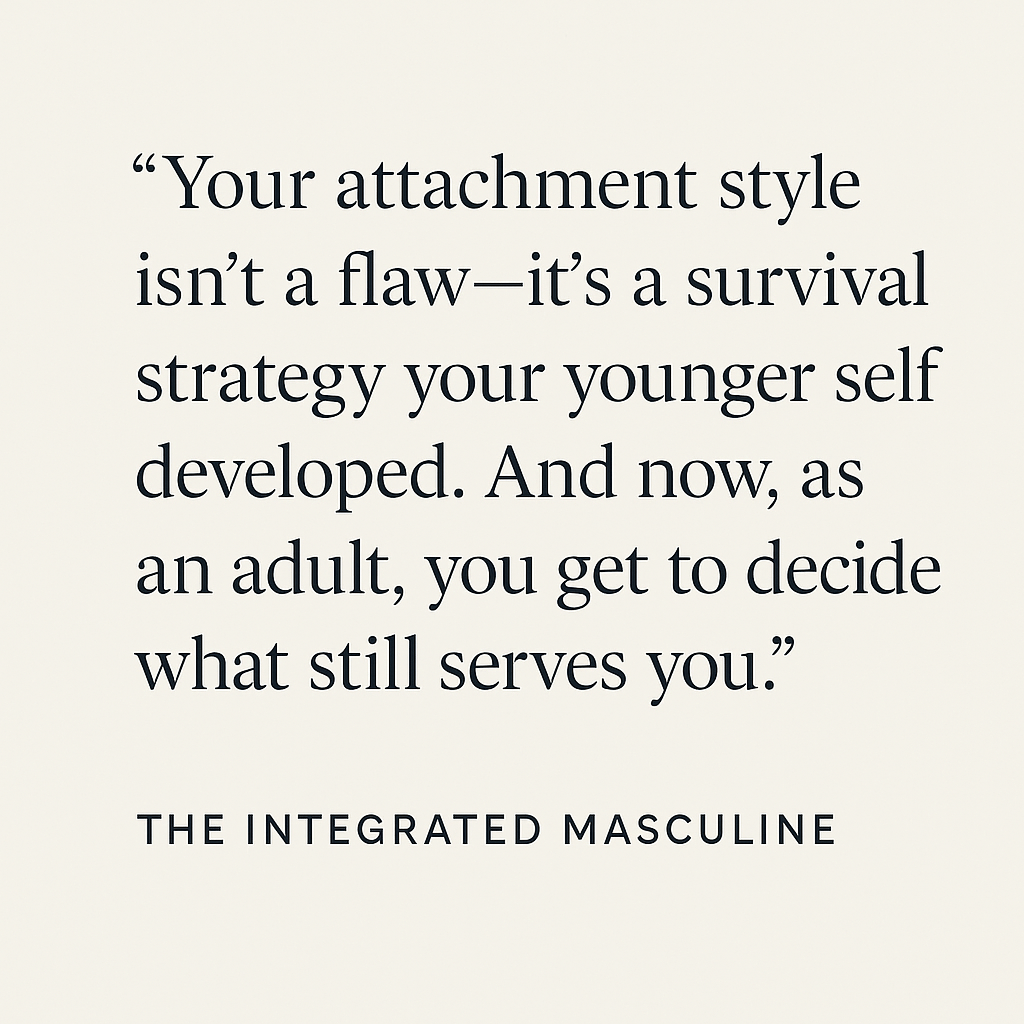
Your attachment style isn’t a flaw. It’s a survival strategy your younger self developed. And now, as an adult, you get to decide what still serves you—and what no longer does.
From weakness to strength
What I really want to focus on here is the transformation: how knowing your attachment style—especially the insecure aspects of it—can become your greatest strength.
- If you’re anxiously attached, you likely have an incredible capacity for empathy and emotional sensitivity.
Learning to self-soothe and trust your own inner voice will make your empathy even more powerful. - If you lean avoidant, you likely value independence and resilience.
Learning to open up emotionally doesn’t make you weak—it deepens your connections and makes your relationships richer. - If you relate to the disorganised style, you’ve probably developed strong intuition and self-awareness.
With the right tools and support, you can build safety from the inside out.
We are not stuck in the attachment style we developed in childhood.
Neuroplasticity means our brains can rewire. Our hearts can relearn safety. And with enough intention, therapy, and healthy relationships, we can move toward secure attachment—even if we didn’t start there.
It begins with you
Whilst it’s helpful to recognise the attachment styles of others—your partner, your ex, your kids, your colleagues—we can’t control them.
What we can control is how we show up.
When we take responsibility for our emotional patterns, we take back our power. We stop reacting and start responding. We become grounded in our masculine presence. And we model security for others—especially our children.
Because healing our attachment style doesn’t just change our relationships.
It changes the legacy we pass on.
–TIM

 The Integrated Masculine
Leave a comment