
It’s a Tuesday morning, and I’m sitting in a laundromat in the heart of Amsterdam. Outside the glass windows, the narrow street is beginning to stir with life. Bicycles clatter past in quick bursts, their bells cutting through the low murmur of voices as locals head to work. The air carries that familiar mix of scents—freshly baked bread wafting from the nearby bakery, damp cobblestones still holding onto the morning drizzle, and the faint, earthy trace of coffee drifting from a café just opening its doors.
The laundromat hums with the steady spin of machines, a kind of background rhythm against the city’s growing bustle. Across from me, a woman about my age feeds coins into a washer. She catches sight of the faded festival logo on my t-shirt, her face breaking into a grin.
“Tomorrowland?” she asks, her accent lilting.
I nod, and within moments we’re sharing fragments of our stories. She’s from Mexico, traveling through Europe on a shoestring, chasing music and new horizons. Her English is patchy, my Spanish even worse, but somehow we manage—our conversation stitched together with hand gestures, laughter, and the occasional translation app assist.
She tells me about her first festival, how she cried when the music swelled and fireworks split the night sky. I tell her about returning again and again, how the rhythm of it feels almost like coming home to a different kind of family. We lean on smiles and tone more than words, discovering that meaning doesn’t always require fluency.
What stays with me isn’t just what we said, but how it felt. The spark of recognition when two people from opposite sides of the world realise they’re carrying the same kind of joy. The ease of it, too—how you can be standing in a laundromat, waiting on socks and t-shirts to dry, and suddenly be reminded that connection doesn’t need polish or planning. Sometimes it just asks that you stay open.
There’s something grounding about that kind of exchange. Two strangers, thousands of miles from home, finding a sliver of common ground in the most ordinary of places. It’s a reminder that travel isn’t just about the postcard views or the grand landmarks—it’s often about the quiet encounters. The simple human moments that gently remind you that you are part of something bigger than your own story.
I enjoy the structure and purpose that my day-to-day life gives me. I am grateful that I get to be in the career that I’ve chosen, doing a role that gives me the flexibility to parent in the capacity I do, and by proxy give me an opportunity to be a present and active father. I am also appreciative that the work is, at times, a high-pressure, demanding role.
Overarching this daily routine, though, is responsibility. Responsibility as a father, responsibility as a leader, responsibility for my own discipline. I think responsibility plays a bigger role in our lives than we give it credit for. It shapes us, grounds us, and—if we’re not careful—sometimes swallows us whole.
And although I’m about to lead into a dialogue about why I value these trips away on my own or with a small group of friends, there is a part of me that foresees a future soon where at least half of my getaways will not be free of parental responsibility. I imagine showing my son the canals for the first time, watching his small hand reach out to feed ducks along the water, or seeing his eyes widen at the sight of windmills turning slowly in the countryside. I’m sure that getting to share the wonder of travel with a little mind will bring with it a kind of magic I can’t yet grasp.
But this entry today focuses more on my lived experience of traveling without my child.
In the lead-up to vacations, people always ask if I’m getting excited for the upcoming getaway, but truthfully it is the release from the weight of responsibility that is the moment I feel that excitement fully—more often than not, when I’m arriving at the airport for departure. There’s something sacred in that liminal space, stepping into a terminal with passport in hand, where the everyday roles and demands of home seem to loosen their grip.
The thought of boarding a flight, consciously disconnected from the outside world for the duration, is sublime. A rare pocket of time where the phone doesn’t matter, the deadlines don’t matter, and for a few hours the only thing to do is simply exist.
These trips allow me to strip back layers and nurture my inner child.
One of the things I am always conscious of when I am abroad is the freedom from deadlines or commitment. The duality of being a co-parent is that some of the time you are solely responsible for your child, while the other percentage of that time is filled with work, recovery, or “filling your own cup.” I tend to maximise my non-parenting time, stacking the days and nights with commitments, which often leads to burnout—or at least rolling into my parenting block with the thought that I need to slow down, to shift gears into a softer rhythm.
Travel reminds me what that slower rhythm feels like.
Much like the scene I opened with earlier, the usual day abroad often starts with an empty canvas. A slow stroll to find breakfast, perhaps some early morning movement, or skipping both and choosing the luxury of a cosy lie-in. The beauty of it is the freedom—the freedom to do what I want, when I want. I don’t have to be at a specific place at a specific time, unless I choose to be.
And in that freedom, I rediscover stillness.
Sometimes it looks like sitting in a café tucked on the edge of a canal, watching the light ripple across the water while boats drift lazily by. Other times it’s finding a quiet park bench, feeling the weight of the world pass through in the footsteps of strangers. I used to do this when I first moved to the city—sit in the middle of the CBD and watch people move in all directions, each one carrying their own unique story, their own invisible battles, their own joys.
Carrying that practice into different corners of the world has been a beautiful thing. To be reminded that the human story is vast and varied, yet deeply connected. That identity is not only who we are in the roles we perform at home, but also who we allow ourselves to be when the weight of those roles is set down, even temporarily.
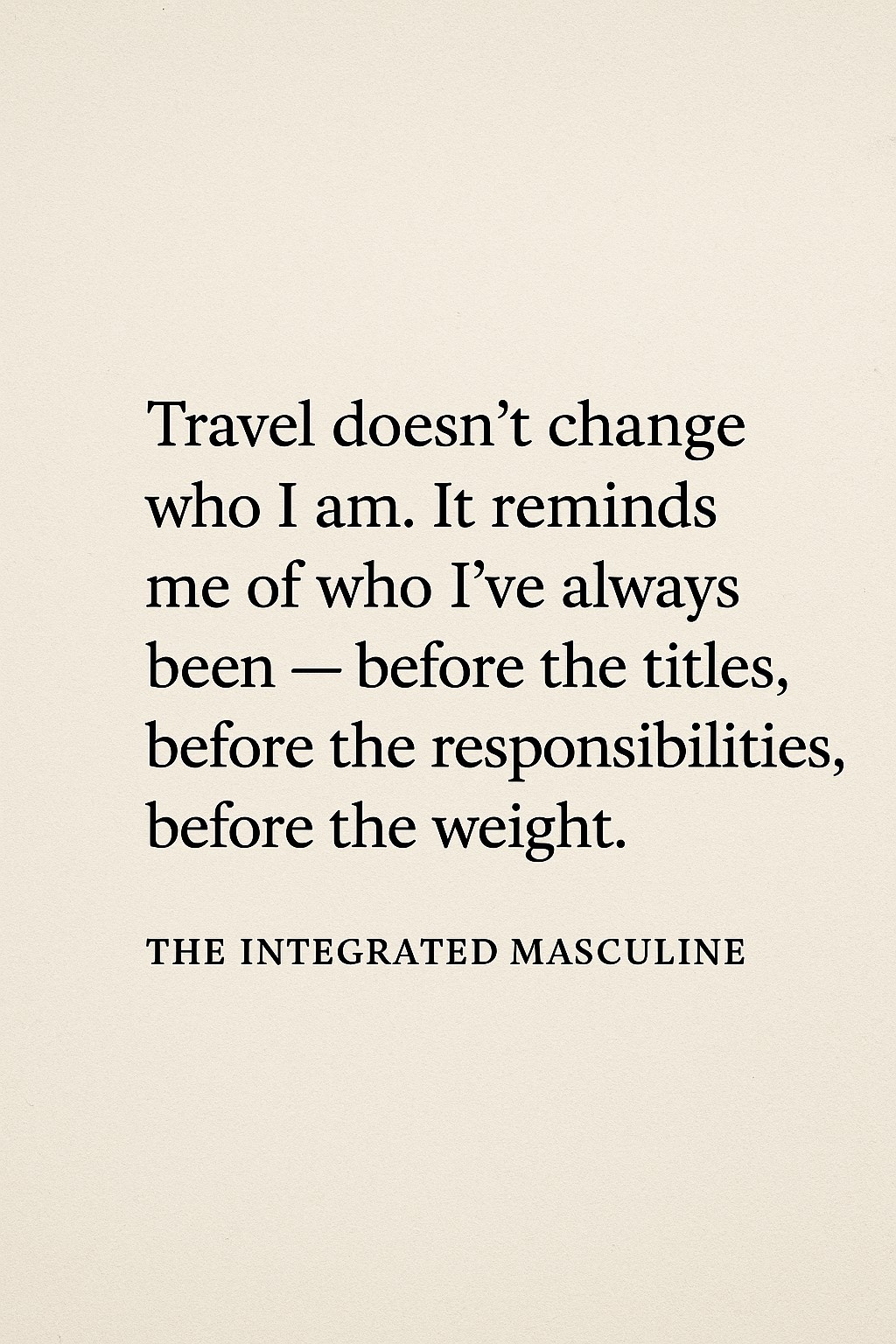
Travel, then, isn’t about escape. It’s about remembering.
When I think back on that trip now, it’s not the grand, postcard-worthy moments that stay with me most. It isn’t the canals lit up by soft evening light, the chaos of festival stages, or even the quiet museums where centuries of history whisper from the walls. What lingers are the quieter, less intentional moments. Like sitting in a laundromat with a stranger from Mexico, laughing through broken sentences and hand gestures, realising that sometimes life’s richest connections don’t need a shared language—just shared presence.
That brief encounter has come back to me more than once since returning home. It was such a small thing, and yet it carried so much weight. In that moment, I wasn’t anyone’s father, son, partner, or professional. I wasn’t even “the traveler.” I was just a man sitting across from another human being, both of us spinning our clothes in foreign machines, bridging cultures with the simplest expressions—laughter, curiosity, and the willingness to listen.
It reminded me of something I too often forget in the busyness of life: identity isn’t only built through what we do. We spend so much time attaching who we are to our achievements, our responsibilities, our roles. But in Amsterdam, sitting there with someone who had no context of my life beyond that moment, I found identity in something more essential—how I showed up in connection. How I could resonate with another person without needing the perfect words. How I could feel seen without explanation, and see someone else without judgment.
That’s the gift travel gave me: the realisation that who I am isn’t locked away in my to-do list, my calendar, or even my long-term goals. Who I am shows up in the openness I allow. The more space I give myself to be curious, to connect, to embrace the unfamiliar, the more I find that identity isn’t something I have to go searching for—it naturally reveals itself.
Coming home, I’ve tried to hold onto that openness. Not just saving it for the next trip abroad, but bringing it into everyday life here. When I’m at the park with my son, I pay closer attention to the small details—the way his laughter echoes through the air, the way strangers smile as they pass, the way the world feels less heavy when I give myself permission to be fully present. When I grab a coffee, I take the extra moment to exchange a genuine word with the barista, instead of rushing past. These aren’t life-changing gestures, but they shift the way I experience life. They remind me that travel isn’t only about new places—it’s about a posture of openness we can choose anywhere.
The laundromat in Amsterdam taught me more than just how to keep my clothes clean on the road. It taught me that identity isn’t found in faraway destinations—it’s found in the ways we choose to show up, both abroad and at home. Travel was the mirror that helped me see it more clearly, but the reflection was always there.
So whilst planning the next holiday might feel like the answer, the truth is simpler: the sense of freedom, curiosity, and connection we find abroad is something we can nurture right here, in the everyday rhythms of our lives. We just have to remember to look for it.
–TIM
 The Integrated Masculine
Leave a comment